
How Does the ResMed AirFit F20 Mask Make CPAP Therapy More Comfortable
March 15, 2026 2026-03-18 10:09How Does the ResMed AirFit F20 Mask Make CPAP Therapy More Comfortable
 respishop_Tech_admin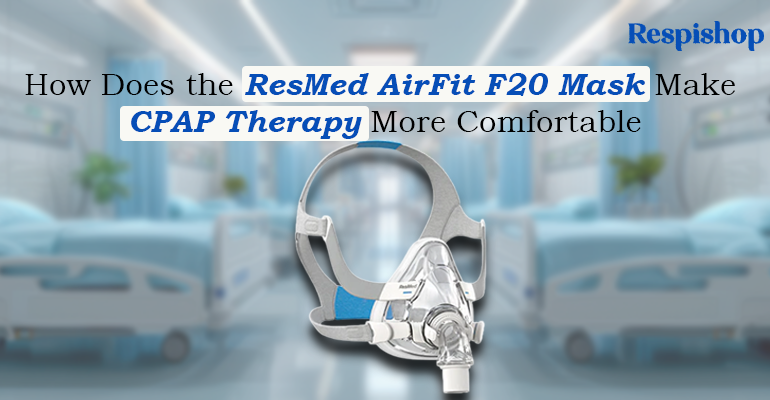
How Does the ResMed AirFit F20 Mask Make CPAP Therapy More Comfortable
It’s midnight, you’ve finally drifted off after a long day, and then you wake up with that familiar hiss of air blowing across your face. Your mask has shifted again. You readjust. You try to fall back asleep. You wake up with a line pressed into your cheek. Sound familiar?
CPAP therapy only works if you actually use the machine, and around 40% of users quit within the first year, usually over something as fixable as a bad mask fit. The ResMed AirFit F20 full face mask is one of the few options that actually seem to solve that problem for people.
Is the AirFit F20 a Full Face Mask?
Yes, it is. The AirFit F20 covers both your nose and mouth, which makes it different from nasal masks or nasal pillow designs that only seal around the nostrils. Mouth breathers, or anyone who wakes up parched despite a nasal mask, will usually find that a full-face design does the job more reliably.
The major benefit here is coverage. When a mask seals over a larger surface area, pressure is distributed more evenly, which is especially important for people in higher-pressure therapy settings. A nasal-only mask can leak or shift under higher pressure, whereas a full-face design holds its position better.
So, How Does the AirFit F20 Work?
The mechanics are the same as with any CPAP mask: a hose, a machine, steady air pressure, and an open airway. What sets it apart is how it seals and stays in place.
The F20 uses a cushion system that adapts to the shape of your face. The cushion has infinity loops, flexible structures that flex and adjust under pressure. So when you roll over or shift positions, the cushion moves slightly with you instead of popping out of place. That flexibility is what separates it from older, stiffer mask designs that would lose their seal the moment you turned your head.
Here are some of its features:
- Adaptive cushion technology that conforms to different nose shapes and facial profiles
- A 360-degree swivel hose connection at the front of the frame, giving you movement without the hose dragging or pulling
- Magnetic headgear clips that snap on and off quickly, useful for bathroom trips or late-night adjustments without fumbling with velcro in the dark
- Four adjustable velcro straps on the headgear for a secure, personalised fit
- A quick-release elbow so you can disconnect from the hose with one hand
Check Out: AirStart 10 APAP: The Not-So-Complicated Smart Sleeper Companion
Can You Sleep Peacefully Without Feeling Pressure Points?
This is where full face masks have historically struggled. The bridge of the nose is the usual trouble spot, the place where cushions press in and leave marks by morning. The F20 addresses this by adding soft padding along the top of the cushion, specifically where it contacts the nose bridge.
The headgear helps too: instead of forehead straps that dig into the brow, it wraps around the sides and back of the head with a soft inner lining, which matters if you sleep on your side and don’t want a hard strap in your cheek all night. And if silicone against the skin is an issue, the frame takes a memory foam cushion, so there’s no need to replace the whole mask.
Is the AirFit F20 Comfortable for All-Night Use?
For most people, yes. While no mask fits everyone perfectly, the F20 design comes with a wide range of face shapes in mind, and the cushion comes in enough sizes that most people find something that works. The real test of a CPAP mask is whether you forget you’re wearing it. That happens when:
- The seal holds without you having to tighten the straps uncomfortably
- The headgear doesn’t shift and creates pressure during movement
- The mask is quiet enough that you don’t notice your own breathing
The F20 ticks all these boxes for many users. Customers who have reviewed it often mention forgetting they’re wearing it, which is about the best compliment a CPAP mask can get.
Does AirFit F20 Stay in Place When You Move in Your Sleep?
Now, this is the real test for any mask, and it’s why flexible cushion design matters. Rigid cushions seal well when you’re lying flat on your back and completely still. The moment you move, the seal breaks. The F20’s cushion flexes as you shift, which means it adjusts rather than losing contact with your face.
Is the AirFit F20 Good for Side Sleepers?
Side sleeping has always been hard with CPAP. Most masks add bulk to the sides of the face, and that bulk gets pushed into the pillow, breaking the seal or pressing uncomfortably into the cheek. The F20’s padded headgear takes some of that pressure off, and the frame arms use a flexible fabric-lined material rather than hard plastic, so they don’t dig into your face when you roll over.
How Noisy Is the ResMed AirFit F20?
The mask operates at around 21 decibels, roughly the level of a soft whisper. Normal conversation runs closer to 60 decibels. For a mask that’s actively venting exhaled air throughout the night, that’s very quiet. It comes down to the vent design at the point where the hose meets the mask. Instead of one or two large openings that concentrate exhaled air into a stream, the F20 uses dozens of tiny holes spread across a wide surface area. The air disperses in multiple directions at once, breaking up the sound and making it less likely to blow directly onto a bed partner.
How Easy Is It to Clean and Maintain the AirFit F20?
The mask consists of six parts: the cushion, the frame, the headgear, the quick-release elbow, and two magnetic clips. That’s a few more pieces than simpler designs, but none of it is complicated to clean.
The cushion gets a wipe-down after each use. Everything else gets a wash with mild soap and warm water once a week. Replacement intervals to keep in mind:
- Cushion: every one to three months
- Headgear: every six months
- Frame: annually
In Summary
The right mask is the one you forget about. The F20 earns its reputation by staying out of the way: seal that holds, noise that doesn’t carry, and a fit that works across a wide range of face shapes and sleep positions. If you’ve been through a few masks without finding one that sticks, it’s worth a try. Check out the ResMed AirFit F20 at Respishop and buy now!
Frequently Asked Questions
- Is the AirFit F20 Good for Changing Sleeping Positions?
Yes, the mask’s design adapts easily, helping reduce leaks when you shift positions.
- Is the AirFit F20 Suitable for Side Sleepers?
Yes, its flexible tube and swivel elbow let side sleepers move comfortably through the night.
- Can Back Sleepers Use the AirFit F20 Effectively?
Absolutely, it fits securely and maintains a steady seal while lying on your back.